
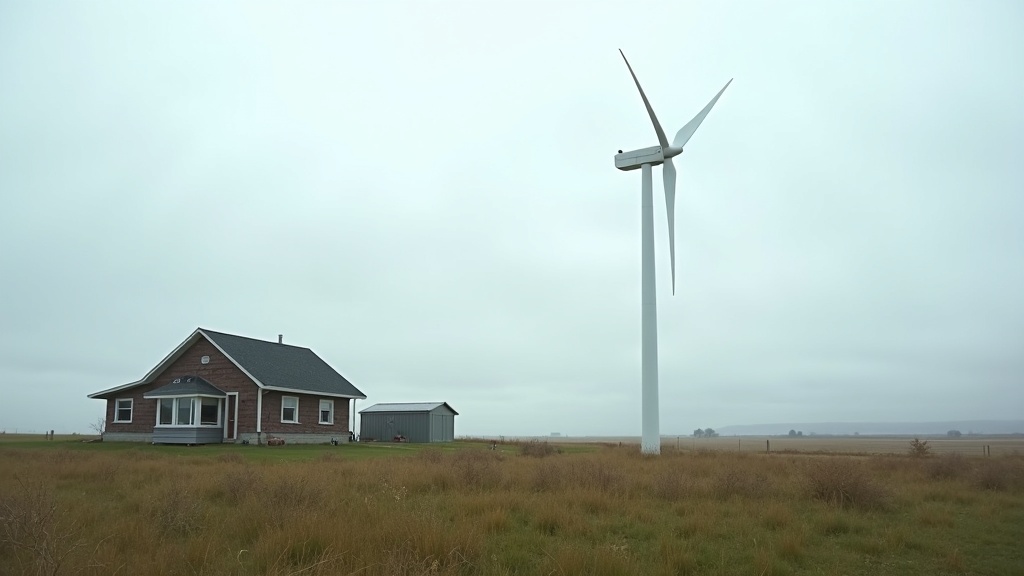
Small residential wind turbines can be practical, but only on properties with consistently strong, unobstructed wind, enough land to place the turbine well away from structures and trees, and local zoning that permits a tower of the needed height. For most suburban and urban lots, the combination of low average wind speed, height restrictions, and setback rules makes a turbine impractical compared with other options. Whether one makes sense for a specific property depends on measurable wind resource, not on marketing claims.
What “small wind” actually means
Small residential wind turbines are generally distinct from the large machines used in commercial wind farms. They range from compact rooftop or pole-mounted units producing a modest trickle of power to freestanding tower systems on rural properties designed to offset a meaningful share of household electricity use. The mechanics are the same physics that apply to any wind turbine — moving air turns blades connected to a rotor, which drives a generator — and the how wind turbines generate electricity explainer covers that process in more detail if you want the mechanical background before evaluating a purchase.
What differs sharply at small scale is exposure to turbulence. Utility-scale turbines sit far above the ground and surrounding obstacles, where wind flows are relatively smooth. A small turbine mounted close to a house, near trees, or in a built-up neighborhood sits inside what’s sometimes called the turbulent boundary layer — air disturbed by buildings, terrain, and vegetation. Turbulent air produces less usable energy and more mechanical stress on the equipment, regardless of how the turbine is rated on paper.
The wind resource question comes first
Before anything else — cost, permitting, aesthetics — the underlying question is whether the property actually has enough wind, and consistently enough, to matter. Average wind speed is typically measured at a standard reference height and then adjusted for the specific tower height and local terrain. Coastal plains, open prairie, and elevated rural land tend to have stronger, steadier wind than valleys, dense suburbs, or anywhere surrounded by trees and buildings.
Wind resource maps published by government energy agencies can give a general sense of regional averages, but average figures for a wide area don’t guarantee what happens on one specific lot. Local topography, nearby structures, and tree cover can change the picture substantially over a distance of a few hundred feet. This is one of the clearest cases where a generic answer doesn’t work — the practicality of small wind is a site-specific engineering question, and getting a real read on it typically means measuring or modeling wind at the actual proposed tower location rather than relying on a regional average.
Tower height and setback rules vary by place
Wind speed increases with height because ground-level obstacles slow air near the surface. This is why small wind systems generally perform better on tall towers — often taller than many neighborhoods will allow. Local zoning ordinances, homeowners’ association rules, and sometimes aviation-related restrictions near airports govern how tall a structure can be and how far it must sit from property lines.
These rules differ not just state to state but often town to town, and they change over time as ordinances get updated. A rural county with large-acreage zoning may permit tall freestanding towers with generous setbacks; a suburban municipality may cap accessory structures at a height that puts any turbine well inside the turbulent zone near the ground, undermining the point of installing one. Anyone seriously considering a small turbine needs to check current zoning and any homeowners’ association covenants for the specific parcel, since a design that works on paper can be legally impossible in a given jurisdiction.
Lot size and setbacks
Beyond height, most jurisdictions that allow small wind turbines specify minimum distances from property lines, structures, and sometimes roads — partly for safety in case of tower or blade failure, and partly for noise. These setback distances are often expressed as a multiple of total tower height, which means a taller tower (the kind that reaches better wind) requires a proportionally larger lot to keep the structure a compliant distance from neighbors.
This is the practical reason small wind tends to suit larger rural properties rather than typical suburban lots: the combination of “needs height to work well” and “needs distance from structures to be legal” adds up to acreage that many properties simply don’t have. A quarter-acre suburban lot is a very different starting point than several acres of open rural land.
Noise, vibration, and neighbors
Moving blades and a generator produce some level of mechanical and aerodynamic noise, and towers can transmit vibration into the ground or into a building if mounted on or near a structure. Some jurisdictions set explicit noise limits for residential wind systems; others leave it to general nuisance ordinances. Either way, proximity to neighbors is a real consideration distinct from the pure energy-output question, and it’s worth asking a local building or zoning office directly what noise and vibration standards apply before assuming a given turbine and tower combination will be acceptable.
How small wind compares with solar as a starting point
For many properties, solar is the more straightforward option to evaluate first, partly because rooftop and ground-mount solar have fewer siting constraints than a tower tall enough to catch usable wind. The rooftop vs ground-mount solar comparison and the general explainer on how solar panels actually work are useful reference points if you’re weighing wind against solar rather than assuming one is automatically better. Some properties can support both technologies, and in some regions a home that lacks good solar exposure — heavy shading, unfavorable roof orientation — happens to have better wind exposure, or vice versa. Neither technology is universally superior; suitability is about matching the resource to the property.
It’s also worth knowing that some incentive programs and net metering rules that apply to solar don’t automatically apply to small wind, and the reverse is also true in some places. Renewable portfolio standards, interconnection rules, and net metering tariffs are set by state or provincial regulators and individual utilities, and they don’t treat every generation technology identically. Confirming how a specific utility handles a small wind interconnection — separate from how it handles solar — is a distinct step, not an assumption to carry over.
Maintenance and mechanical wear
Unlike solar panels, which have no moving parts in the panel itself, small wind turbines have a rotor, generator, and often a yaw mechanism that turns the turbine to face changing wind direction — all mechanical components subject to wear, especially in turbulent, gusty conditions typical of built-up areas. Manufacturers specify maintenance intervals and expected component lifespans, and those specifications, along with warranty terms, are the kind of detail worth getting in writing from the manufacturer or a qualified installer rather than estimating independently.
Questions worth asking before deciding anything
- What is the measured or modeled average wind speed at the proposed tower height on this specific property, not just the regional average?
- What does local zoning currently allow for tower height, and what setback distances apply from property lines and structures?
- Does a homeowners’ association or historic district have separate restrictions that could apply regardless of zoning?
- How does the utility’s interconnection and metering process handle small wind specifically, as opposed to solar?
- What maintenance schedule, expected component lifespan, and warranty terms does the manufacturer specify?
- What noise level is the system rated at, and how does that compare with any local noise ordinance?
Broader background on how wind energy scales up, including the differences between the small systems discussed here and the much larger turbines used in commercial generation, is covered in the wind energy section, along with a look at the distinct engineering tradeoffs in the offshore vs onshore wind comparison. For readers weighing wind against other renewable options, the solar energy archive and the piece on community solar cover alternatives that don’t require owning generation equipment on-site at all.
Frequently asked questions about small residential wind turbines
Do small wind turbines work on a regular suburban lot?
Usually not well, because suburban lots tend to have height restrictions and setback rules that keep towers short and close to buildings and trees — exactly where wind is weakest and most turbulent. Rural properties with more open land and taller allowable towers are generally a better fit.
How much wind do you need for a home turbine to be worth considering?
There’s no single threshold that applies everywhere, because output depends on average wind speed at the actual tower height, local turbulence, and the specific turbine’s characteristics. A site-specific wind assessment, rather than a regional average, is the only way to get a meaningful answer for a particular property.
Can you combine a small wind turbine with solar panels at home?
Yes, hybrid systems combining small wind and solar exist, and some rural properties have both a usable wind resource and good solar exposure. Whether combining them makes sense depends on the property’s specific wind and solar resources, available space, and how the local utility handles interconnecting multiple generation sources.
Do you need a permit to install a small wind turbine at home?
In most places, yes — local building and zoning departments typically require permits covering tower height, setbacks, and sometimes structural or electrical inspection. Requirements vary by municipality and change over time, so checking with the local zoning or building office directly is the reliable way to confirm current rules.
Are there tax credits or rebates for residential wind turbines?
Various federal, state, provincial, and utility programs have historically supported small wind installations, but eligibility, amounts, and expiration dates vary by location and change over time. Confirming current terms with the official program administrator or your utility is the only reliable way to know what applies to a specific property.
The Cleaner Energy publishes general information about clean energy technology, not financial, tax, legal or engineering advice. We are writers and editors, not installers, contractors or financial advisers. Incentives, rebates, utility rates and equipment costs vary by location and change over time — confirm current figures with the official program administrator, your utility, or a licensed local professional before making a purchase or installation decision.