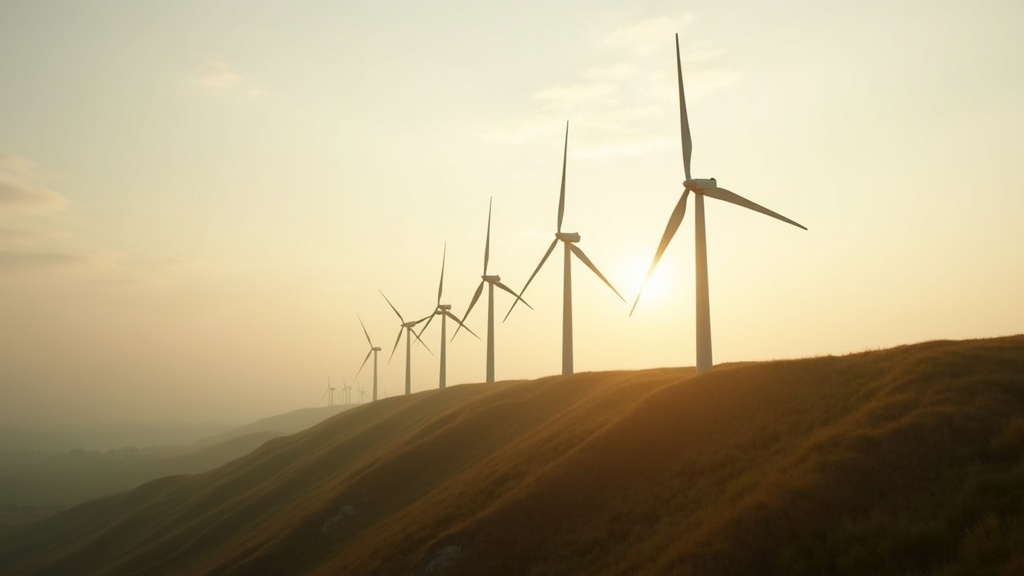
Wind power’s history stretches back more than a thousand years, from grain-grinding windmills in Persia and Europe to the electricity-generating turbines dotting hillsides and coastlines today. The throughline is mechanical: capturing moving air to do work that would otherwise require human, animal, or fossil-fuel effort. What changed over centuries is the scale, the materials, and eventually the purpose — from milling flour and pumping water to feeding electrical grids. Understanding that arc helps explain why modern turbines look and work the way they do.
Early windmills: mechanical power before electricity
The earliest documented windmills appeared in the region that is now Iran and Afghanistan, roughly in the 9th century, using vertical-axis designs to grind grain. Europe developed its own tradition starting around the 12th century, with horizontal-axis post mills that could be rotated to face the wind. By the Middle Ages, windmills were common across the Netherlands, England, and northern Europe, used for milling grain, sawing timber, and — critically for the Dutch — pumping water to drain low-lying land and reclaim it for agriculture.
These were purely mechanical machines. A rotating shaft connected to gears and grindstones or pumps did the work directly; there was no electricity involved. Wind power at this stage was a substitute for muscle, not a power source in the modern sense. It remained a mainstay of rural economies for hundreds of years, particularly in places with strong, consistent winds and few fast-flowing rivers to power water mills instead.
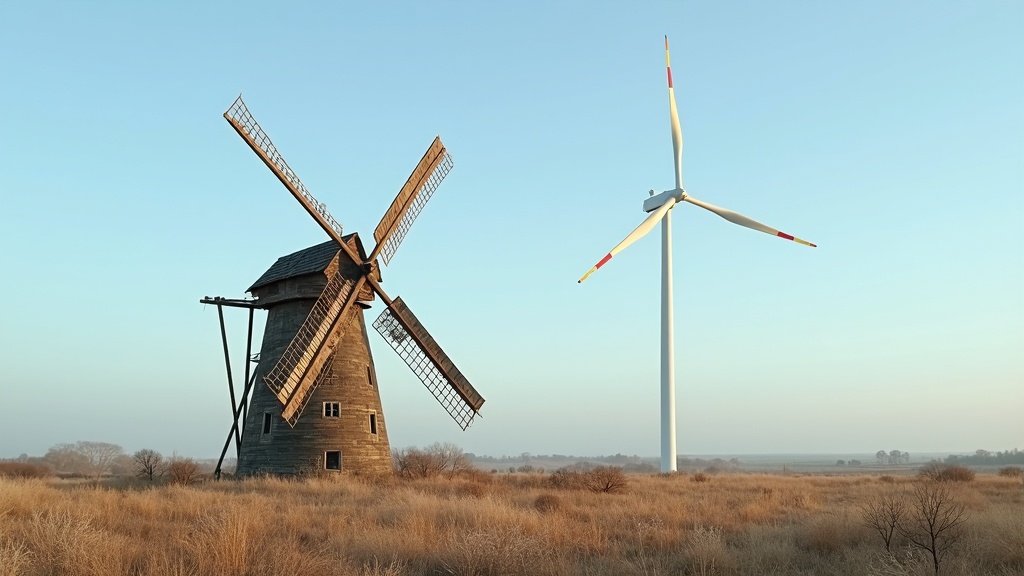
The 19th century: wind meets electricity
The shift from mechanical wind power to electrical wind power began in the late 1800s, as inventors experimented with connecting wind-driven rotors to the newly developed dynamo. Small wind-electric systems appeared in rural areas of the United States, Denmark, and elsewhere, often used to charge batteries for isolated farms not yet reached by electrical grids. These early wind-electric machines were modest in scale — enough to power a few lights or a radio — but they established the basic principle still used today: a rotor turns a shaft, and that shaft drives a generator rather than a millstone.
Denmark, in particular, became an early center of wind-electric development, partly through government-supported research programs in the early 20th century. Rural electrification efforts in the U.S. also relied on small wind-electric units for a period, especially in the Great Plains, before large-scale grid extension made them largely unnecessary in most areas.
Mid-20th century: interest fades, then returns
As centralized power grids expanded and fossil-fuel and hydroelectric generation became cheap and widely available, small-scale wind-electric systems fell out of use across much of the developed world by the mid-20th century. Wind power didn’t disappear from research entirely — some experimental utility-scale turbines were built in the 1940s and 1950s, including a notable installation in Vermont that briefly fed power into a local grid — but it remained a minor curiosity next to coal, oil, and hydro.
Renewed interest arrived with the energy crises of the 1970s, when oil price shocks pushed governments and researchers to look seriously at alternatives to imported fossil fuels. Public funding in the U.S., Denmark, Germany, and elsewhere supported new turbine research programs, and this period produced many of the aerodynamic and structural principles still used in turbine design. It also produced a wave of turbines in California’s wind resource areas during the 1980s, driven by state and federal policy support — an early example of how incentive programs, not just technology, shape where and when wind power gets built.
The modern turbine takes shape
The three-blade, horizontal-axis turbine that now dominates the industry emerged from this period of experimentation, eventually outcompeting alternative designs like vertical-axis and two-blade configurations on the basis of efficiency, reliability, and noise characteristics. Danish manufacturers were particularly influential in standardizing the three-blade upwind design during the 1980s and 1990s, and that basic layout has scaled up dramatically since — from turbines producing a small fraction of a megawatt to modern machines with far larger rotor diameters and capacities. If you want the mechanical detail of how a contemporary turbine actually converts moving air into electricity, that process is covered separately in how wind turbines generate electricity.
Turbine size grew for a straightforward physical reason: wind speed generally increases with height, and swept rotor area determines how much energy can be captured, so taller towers and longer blades unlock more consistent and greater output. That same logic is part of why offshore locations, where wind tends to be stronger and steadier over open water, became attractive once the engineering and cost challenges of building at sea were addressed — a comparison explored in offshore vs onshore wind: what actually differs.
Wind power’s expansion into today’s grid
From the 1990s onward, wind power moved from a niche, subsidy-dependent technology into a mainstream part of electricity generation in many countries, driven by falling equipment costs, improved turbine reliability, and sustained policy support in various forms. That support has varied enormously by country and by decade — production incentives, capacity targets, renewable portfolio standards, and grid interconnection rules have all shaped where wind farms got built and how quickly. Because these programs differ by jurisdiction and change over time, anyone trying to understand current wind policy in a specific place should check with that region’s energy regulator or program administrator rather than relying on historical patterns.
Utility-scale wind and utility-scale solar have often developed in parallel, sometimes at the same sites or under the same ownership, and the broader landscape of solar development is covered on this site’s Solar Energy hub, alongside the dedicated Wind Energy section covering turbines specifically.
Small-scale and residential wind, then and now
Interest in small, individual wind-electric systems has never fully disappeared, and it periodically resurfaces alongside interest in home solar. The physical constraints are different from utility-scale wind, though: residential lots often lack the sustained, undisturbed wind speeds that make a small turbine worthwhile, and local zoning, height restrictions, and noise rules add further limits that vary by municipality. The practical considerations involved in evaluating a home turbine are covered in more detail in small residential wind turbines: are they practical?, which is worth reading before treating small-scale wind as a straightforward parallel to rooftop solar.
What the history explains about today’s technology
Wind power’s long history is mostly a story of mechanical refinement rather than a sudden invention: the physics of capturing moving air has stayed the same for a thousand years, while materials, aerodynamics, and generator technology have steadily improved what’s possible to build and where. It also explains why wind power’s growth has always tracked policy as much as engineering — early Dutch windmills responded to land-reclamation needs, 1970s turbines responded to oil shocks, and today’s utility-scale wind farms respond to a mix of cost trends and incentive structures that differ by country and region. That pattern of location-specific policy is why current programs, rules, and figures should always be confirmed with the relevant program administrator or utility rather than assumed from what’s true elsewhere.
Frequently asked questions about the history of wind power
When was wind power first used to generate electricity?
Wind-electric machines began appearing in the late 19th century, connecting rotors to early dynamos, mostly for small-scale rural electrification. This was distinct from windmills, which had used wind mechanically for centuries before electricity generation was possible.
Who invented the first wind turbine?
There isn’t a single inventor credited with “the” wind turbine; development was incremental across multiple countries, with Denmark, the U.S., and others contributing key steps between the late 1800s and the late 20th century when the modern three-blade design became standard.
Why did three-blade turbines become the standard design?
Three-blade, horizontal-axis turbines outcompeted earlier vertical-axis and two-blade designs on efficiency, structural balance, and noise, based on decades of testing during the 1970s-1990s research boom. Danish manufacturers were particularly influential in standardizing this layout.
How has wind turbine size changed over time?
Turbines have grown substantially in height and rotor diameter since the 1980s, because taller towers reach steadier, stronger wind and larger rotors capture more energy per turbine, though exact size trends and current typical dimensions vary by manufacturer and market.
Is wind power older than solar power?
Yes — mechanical wind power dates back roughly a thousand years to early windmills, while solar photovoltaic technology wasn’t developed until the mid-20th century. For how solar panels actually convert sunlight into electricity, see how solar panels actually work.
Related reading
The Cleaner Energy publishes general information about clean energy technology, not financial, tax, legal or engineering advice. We are writers and editors, not installers, contractors or financial advisers. Incentives, rebates, utility rates and equipment costs vary by location and change over time — confirm current figures with the official program administrator, your utility, or a licensed local professional before making a purchase or installation decision.