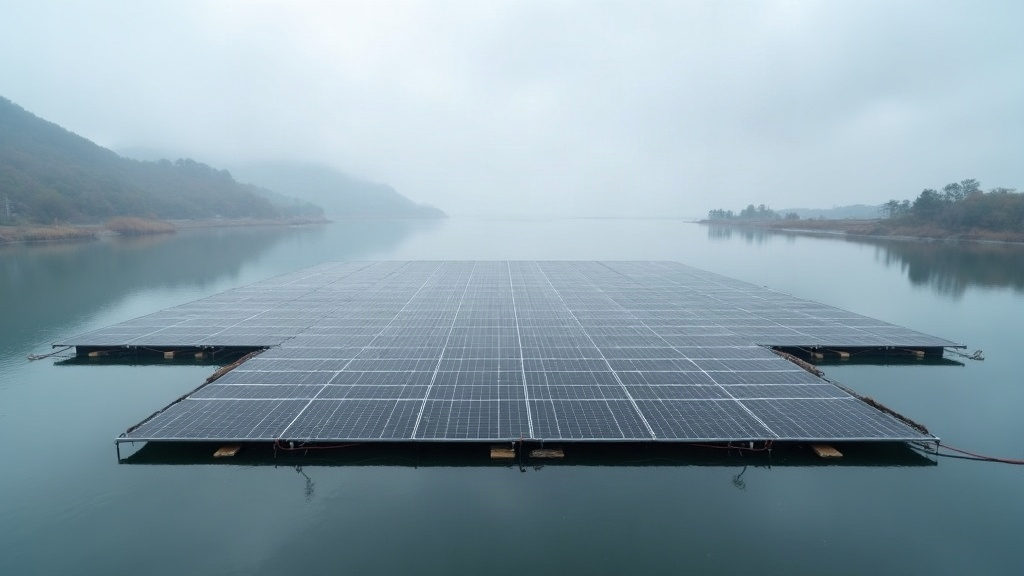
Floating solar farms, sometimes called floatovoltaics, are arrays of solar panels mounted on buoyant platforms that sit on the surface of a reservoir, lake, or quarry pond instead of on land or a rooftop. The panels are anchored in place, cabled together, and connected to shore through underwater or floating conduit. They work on the same photovoltaic principle as any solar panel, but the water underneath changes the engineering problem entirely — and it also rules out most bodies of water as realistic sites.
That second part rarely gets explained. Most coverage of floating solar repeats the same three benefits — it saves land, it cuts evaporation, it runs a bit cooler — without ever answering the question a reader with an actual reservoir on their property is asking: does my water body even qualify? That’s the part this article focuses on.
How the system actually sits on the water
A floating array is built from modular plastic or metal pontoons, shaped roughly like docks, that snap or bolt together into a floating grid. Standard solar panels — often the same panels used in ground-mount arrays, covered in how solar panels actually work — are tilted at a shallow angle and bolted to the pontoons. The whole raft is held in position by a mooring and anchoring system: cables running to the shoreline, to concrete blocks on the lakebed, or to driven piles, depending on depth and bottom conditions.
Electrical wiring runs along the floats to a junction point, then through a floating or buried cable to shore, where it meets an inverter and a connection to the grid or to an on-site load. Some projects also mount the inverters themselves on floating platforms, raised above potential splash. Everything has to tolerate constant motion, humidity, and UV exposure well beyond what a rooftop system sees.
The site checklist: what actually determines viability
This is the part that separates a real candidate site from a nice idea. Developers and engineers weigh several hard constraints before a reservoir is taken seriously. None of these numbers are universal law — they vary by equipment manufacturer, mooring design, and local permitting — but they describe the ranges the industry generally treats as workable, and they explain why so many ponds and lakes get ruled out immediately.
| Factor | General threshold considered workable | Why it matters |
|---|---|---|
| Water depth | Roughly 3 feet (about 1 meter) minimum at the shallowest anchor point, with several feet more preferred | Anchors and mooring lines need enough depth to hold position without grounding the array during low water |
| Water level fluctuation (drawdown) | Arrays are generally designed around a known seasonal swing; very large or unpredictable drawdowns complicate mooring design significantly | Anchors and slack cable length have to account for the lowest and highest expected water levels, not just the average |
| Ice cover | Sites with sustained, thick seasonal ice cover are usually excluded or require specialized ice-rated floats | Standard pontoons and cabling are not built to withstand ice sheet movement and pressure |
| Wind and wave fetch | Open-water fetch distances beyond a few miles raise wave height risk and generally call for reinforced or wave-rated mooring | Longer uninterrupted wind runs build larger waves, which stress anchors and float connections |
| Distance to grid connection | Shorter distances to an existing substation or distribution line are strongly preferred; long runs add substantial cabling and trenching cost | Underwater and underground cable runs are expensive and add a point of failure |
| Water use conflicts | Sites with active boating, fishing leases, flood control duties, or drinking-water intakes need those uses mapped before sizing coverage | Floating arrays typically cover a portion, not all, of a water body’s surface to preserve other uses |
A reservoir behind a hydroelectric dam, for example, often fails the drawdown test — many are drawn down by tens of feet between wet and dry season, which makes mooring design far harder and more expensive. A small farm pond might pass on depth and fetch but fail on grid distance if the nearest substation is miles away. A quarry pond near an industrial site, by contrast, often checks every box: steady depth, short fetch, minimal competing uses, and a nearby connection point. That’s part of why floating solar has concentrated on former mine pits, irrigation reservoirs, and water utility basins rather than natural lakes.
None of these thresholds is a formal engineering standard you can look up in one place; they come from the practical constraints that mooring and float manufacturers design around, and from siting guidance published by research groups. The National Renewable Energy Laboratory has documented how depth, drawdown, and ice exposure narrow the pool of workable sites in its floating PV research. A joint report from the World Bank Group, ESMAP, and the Solar Energy Research Institute of Singapore, titled “Where Sun Meets Water,” lays out similar siting factors in more technical detail for anyone evaluating a specific reservoir.
Why water-cooling and shade actually matter
Solar panels lose some efficiency as they heat up — a well-documented effect covered in more depth in our piece on solar panel efficiency and degradation over time. Water beneath a floating array draws heat away from the panels more effectively than open air does, which can modestly improve output on hot days compared to a similar rooftop or ground array at the same location. The effect depends on wind, water temperature, and how high the panels sit above the surface, so it varies by site rather than applying as a fixed bonus everywhere.
The water also loses something in the exchange. Shade from the panels reduces evaporation from the covered area, which matters most in drought-prone regions where reservoirs serve as drinking water or irrigation supply. It also reduces sunlight reaching the water underneath, which can suppress algae growth in some reservoirs — a benefit utilities managing algal blooms have taken a real interest in — but can also affect fish and plant life in ways still being studied. Coverage percentage, not total elimination of sunlight, is usually the design goal.
Land savings and why that’s the real draw for many utilities
Ground-mount solar needs land — cleared, graded, fenced, and often taken permanently out of other use. Floating solar sidesteps that by using water surface already owned or controlled by a utility, agency, or company, often at a site that has no competing development value anyway. That’s a different trade-off than the one described in our comparison of rooftop vs. ground-mount solar, where the land itself usually belongs to the system owner already. It’s also a different model from agrivoltaics, which shares farmland between crops and panels rather than moving the array onto water.
For a water utility or irrigation district, this often means putting solar on an asset that was otherwise generating no revenue. For a municipality with a capped landfill or an old quarry pit full of water, it can mean a use for a parcel that’s hard to repurpose any other way. These are the buyers who dominate current floating solar deployment — utilities, industrial water users, and municipalities — rather than individual homeowners, because the engineering and permitting involved sits well beyond a residential project.
Maintenance and lifespan questions that differ from rooftop solar
Floating systems need periodic inspection of mooring lines, anchors, and float seams, usually by boat or with diving work for underwater components. Biofouling — algae and mussels attaching to submerged float surfaces — is a recurring maintenance item in freshwater and especially brackish sites. Cabling connections are a known weak point, since they sit in a humid, moving environment rather than a fixed rooftop.
Expected equipment lifespan for the panels themselves tracks ordinary solar panels, generally in the range manufacturers warrant for ground-mount systems. The floats, anchors, and mooring hardware are a separate question, and their service life depends heavily on water chemistry, UV exposure, and ice or wave stress at the specific site. Anyone evaluating a proposal for an existing reservoir should ask what the float and mooring warranty actually covers, separate from the panel warranty — they are not the same commitment.
Grid connection and interconnection still apply
A floating array connecting to a utility grid goes through the same interconnection process as any other generator of its size — application, technical review, and agreement with the utility or grid operator before energization. The scale and ownership structure differ from a home rooftop system, but the underlying process shares ground with what’s described in our explainer on utility interconnection for home solar. Larger floating projects feeding directly into the transmission system follow a utility-scale version of that review, often involving longer timelines and more detailed grid-impact studies.
Policy support for floating solar specifically is thin compared to rooftop or ground-mount solar in most jurisdictions. Some regions treat it under the same renewable energy incentive and permitting frameworks as any solar project; others have no specific category for it at all, and project developers have had to work through water-rights, navigation, and environmental permitting processes designed for other purposes. Anyone tracking incentive eligibility for a specific project should check directly with the relevant state energy office or program administrator, since treatment varies by location and changes over time — our broader piece on finding legitimate clean-energy incentive programs covers how to verify that a program is current and real.
Where floating solar fits in the bigger storage and grid picture
Floating arrays generate power the same way any solar array does: intermittently, following the sun. Pairing floating solar with storage, whether on-site batteries or broader grid-scale systems described in our piece on grid-scale energy storage, follows the same logic as pairing storage with any solar generation — it’s about shifting output to match demand, not a feature unique to floating installations. Some floating projects are paired with existing hydroelectric dams specifically because the dam’s generators can ramp up and down to smooth out solar’s variability, an arrangement sometimes called hybrid hydro-floating solar.
For readers trying to place floating solar in context, it helps to think of it as one more land-use strategy within solar deployment broadly, alongside rooftop, ground-mount, and dual-use approaches — not a separate technology. The panels, inverters, and grid connection work the same way described across our wider coverage in the how clean energy works hub and the solar energy archive. What changes is everything underneath the panels: the float, the anchor, and the site assessment that decides whether a given reservoir can host them at all.
The Cleaner Energy publishes general information about clean energy technology, not financial, tax, legal or engineering advice. We are writers and editors, not installers, contractors or financial advisers. Incentives, rebates, utility rates and equipment costs vary by location and change over time — confirm current figures with the official program administrator, your utility, or a licensed local professional before making a purchase or installation decision.