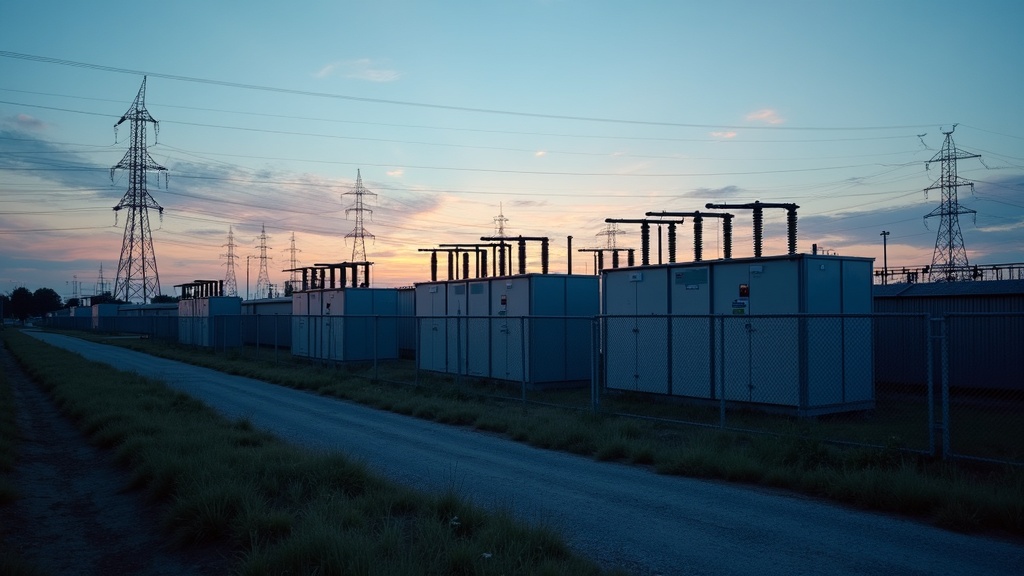
Grid-scale energy storage refers to large systems — usually banks of batteries, but sometimes pumped hydro, compressed air, or other technologies — that store electricity for the grid itself rather than for a single home or business. These systems soak up power when supply is abundant or cheap and release it when demand spikes or generation drops, helping utilities balance the grid minute to minute and season to season. They operate at a scale of megawatts to gigawatts, far beyond what a home battery does. Understanding the basics helps make sense of why utilities, regulators, and renewable energy debates keep coming back to storage.
What “grid-scale” actually means
A home battery, the kind discussed in how home battery storage actually works, typically stores a handful of kilowatt-hours to cover part of a house’s usage during an outage or evening peak. Grid-scale storage is a different order of magnitude — facilities are measured in megawatt-hours or gigawatt-hours, and they connect directly to transmission or distribution networks rather than to a single building’s electrical panel. They’re owned and operated by utilities, independent power producers, or grid operators, not by homeowners, and their job is to serve thousands or millions of customers at once rather than one household.
The main technologies in use
Several different approaches to storing electricity exist at grid scale, and each has different strengths, costs, and geographic requirements.
Lithium-ion battery systems
The fastest-growing category today is large lithium-ion battery installations, essentially the same underlying chemistry used in electric vehicles and home batteries, but assembled in shipping-container-sized units and wired together by the hundreds. The chemistry details and trade-offs are covered in more depth in lithium-ion vs other home battery chemistries explained, and much of that logic — energy density, cycle life, thermal management — scales up to grid installations, just with far more oversight, cooling infrastructure, and fire-safety engineering involved.
Pumped hydro storage
The oldest and still largest form of grid storage worldwide, pumped hydro works by pumping water uphill to a reservoir when electricity is cheap or plentiful, then releasing it downhill through turbines to generate power when it’s needed. It requires specific geography — elevation change and water access — so it isn’t an option everywhere, but where it exists it can store enormous amounts of energy for long periods.
Compressed air and other mechanical storage
Some facilities compress air into underground caverns or containers, then release it to drive turbines later. Flywheels, which store energy in a spinning mass, are used for short-duration, fast-response applications rather than long-term storage. These technologies are less common than batteries or pumped hydro but occupy specific niches where their particular response speed or duration profile fits a grid operator’s needs.
Thermal and other emerging approaches
Some projects store energy as heat — in molten salt, heated rock, or other materials — then convert it back to electricity or use it directly for heating applications. These remain a smaller slice of total grid storage capacity but are being tested in various pilot projects as a way to extend storage duration beyond what batteries currently offer economically.
Why the grid needs storage in the first place
Electricity has historically been generated at almost the exact moment it’s used, because storing it cheaply was hard. That worked reasonably well when power plants could be ramped up or down on demand. But as more electricity comes from sources like solar and wind — covered in the site’s solar energy and wind energy sections — the timing of generation and the timing of demand no longer line up as neatly. The sun doesn’t shine at night when people still need electricity, and wind output can swing hard depending on weather. Storage bridges that mismatch: it captures surplus generation during high-output hours and shifts it to periods when generation is low but demand persists.
Storage also helps grid operators manage short-term stability — smoothing out sudden changes in supply or demand within seconds — and provides backup capacity during extreme weather events or unexpected plant outages. In this way it functions similarly to a home battery paired with solar, just serving an entire region instead of one house; the concept of storing surplus generation for later use, explained in how solar panels actually work, applies at both scales even though the equipment and coordination look very different.
How storage gets paid for and who owns it
Grid-scale storage projects are typically developed by utilities, independent energy companies, or a mix of both, and the money involved comes from a combination of private investment, ratepayer funding through utility rates, and public incentive programs designed to encourage clean energy infrastructure. Programs and eligibility rules vary significantly by country, state, or province, and they change over time as budgets and policy priorities shift. Anyone trying to understand what’s driving a particular storage project in their area — or what it might mean for their utility bill — should check with the relevant utility commission, grid operator, or official program administrator rather than relying on a general explainer, since the details are genuinely local and genuinely change.
How grid storage differs from home battery storage
It’s worth being clear about what grid-scale storage is not: it is not a substitute for a home battery, and having grid storage nearby doesn’t mean a household’s power stays on during a local outage, since outages are often caused by problems in the distribution lines closer to the home rather than a shortage of generation. Readers specifically interested in what a battery at their own home would and wouldn’t cover during an outage can find that distinction laid out in what a home battery backup actually covers in an outage. Grid-scale storage operates at the level of the broader transmission and distribution system, balancing supply and demand across a wide area, while a home battery operates entirely within a single property’s wiring.
What determines whether a storage project makes sense in a given place
Several factors shape whether and how much grid-scale storage gets built in a region: the mix of generation sources already on the grid, the price and availability of alternatives like natural gas peaker plants, local geography for options like pumped hydro, regulatory rules about who can own and operate storage assets, and how electricity markets in that area compensate storage for the services it provides. These variables differ enormously by country and even by utility territory within the same country, which is why one region’s storage buildout can look completely different from another’s in scale, technology choice, and pace.
Frequently asked questions about grid-scale energy storage
What is grid-scale energy storage used for?
It’s used to balance electricity supply and demand across a utility or regional grid — storing surplus power when generation is high and releasing it when demand rises or generation drops, which helps integrate variable sources like solar and wind and improves overall grid reliability.
Is grid-scale battery storage the same as a home battery?
No. Grid-scale storage operates at a much larger scale, is owned by utilities or energy companies, and serves the entire grid, while a home battery is a much smaller system that stores power for a single household’s own use, often alongside rooftop solar.
Does grid storage keep my power on during an outage?
Not necessarily. Many outages happen because of damage or faults in local distribution lines rather than a shortage of generation, so grid-scale storage doesn’t guarantee an individual home stays powered; a home’s own backup options are a separate question from grid-level storage capacity.
What technology is most common for grid-scale storage today?
Lithium-ion battery installations have become the fastest-growing technology for new grid-scale storage projects in many regions, while pumped hydro remains the largest source of total storage capacity worldwide due to its long history and large scale at existing sites.
Who pays for grid-scale energy storage projects?
Funding typically comes from a mix of private investment, utility ratepayer funds, and government incentive programs, with the exact structure varying by country, state, or utility; details on current programs should be confirmed with the relevant utility commission or program administrator.
The Cleaner Energy publishes general information about clean energy technology, not financial, tax, legal or engineering advice. We are writers and editors, not installers, contractors or financial advisers. Incentives, rebates, utility rates and equipment costs vary by location and change over time — confirm current figures with the official program administrator, your utility, or a licensed local professional before making a purchase or installation decision.